Category:
Product Design, Branding, Logo Design
A modern iteration of the traditional cultural salon, HAUS values intellectual curiosity and social interaction of the highest degree. Haus strives to create an atmosphere for its members to be the most thoughtful and expressive versions of themselves. HAUS is an iOS app for urban Millenials/younger Gen X’ers seeking an elevated digital experience. The primary function is to provide curated, high-quality events, and media for members.
Context
Haus is a concept-stage iOS app targeting urban millennials and younger Gen X'ers who feel underserved by mainstream event platforms. Where Eventbrite and Facebook Events cast a wide net, Haus aimed to go the opposite direction, a curated, membership-based experience for people who value quality over quantity in their social and cultural lives. Think of it as a modern iteration of the intellectual salon: high-quality events, thoughtful media, and a community that feels earned rather than open to anyone.
The Problem
The client came to me with a compelling vision and not much else. No brand, no visual direction, no defined flows, just a clear sense of what Haus should feel like and one non-negotiable product requirement: it had to feel exclusive.
That vagueness was both the challenge and the opportunity. My job was to translate a feeling into a product — giving Haus a visual identity, a brand voice, and a user experience that made exclusivity feel designed-in rather than bolted on.
My Role
I was the sole designer on this project, responsible for brand strategy, logo design, user flow mapping, wireframes, and high-fidelity prototyping in Adobe XD. This was a ground-up engagement — from first stakeholder conversation to final design handoff.
Discovery
With no existing product to learn from and a primarily stakeholder-driven brief, I focused the early phase on extracting as much signal as possible from the client about the audience, the competitive landscape, and the emotional territory Haus wanted to own.
What became clear quickly was that exclusivity wasn't just a feature, it was the product's core value proposition. Everything else needed to serve it. The target audience wasn't looking for more events to scroll through; they were looking for a reason to feel like they were in the right room.
That insight reframed the design challenge entirely.
Framing the Problem
How might we design an app experience where exclusivity isn't just communicated, it's felt at every touchpoint, from the moment you're invited to the moment you pass an invite along?
Process
Visual Direction & Stylescapes
Before touching any product screens, I developed stylescapes to establish the visual tone. For Haus, the direction needed to balance modern minimalism with a sense of cultural sophistication, something that felt premium without being cold. The finalized stylescape gave us a shared aesthetic language before a single screen was designed.
Logo Design
The logo presented an interesting constraint: the client wanted a monogram that incorporated all four letters H, A, U, S while still feeling modern and intentional rather than busy. The challenge was making four letters read as one cohesive mark. The solution was a tightly constructed monogram that treats the letterforms as a unified system, giving Haus a distinctive visual identity that works as an app icon, a wordmark, and a brand stamp.
User Flow Mapping
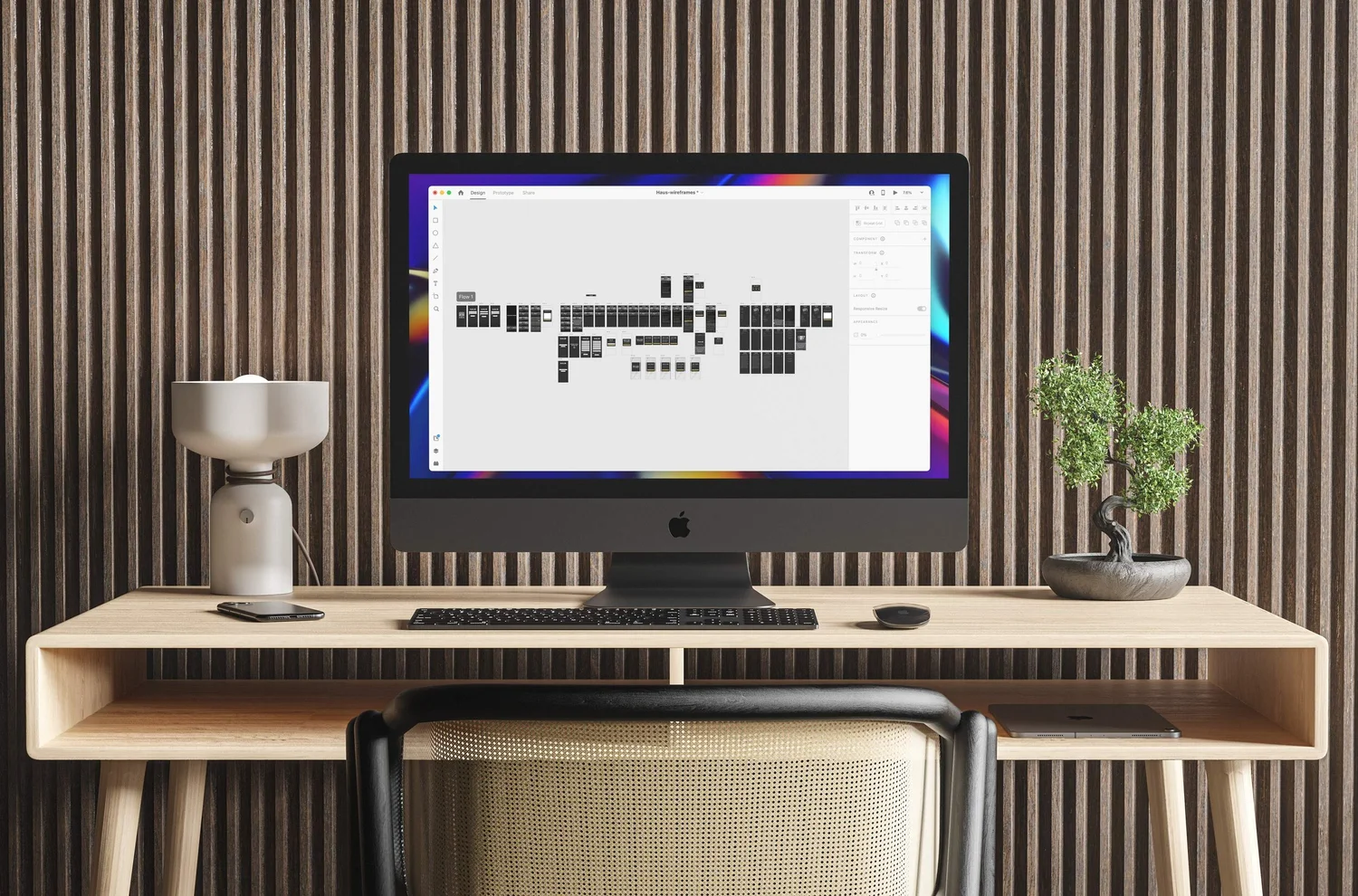
With the brand direction established, I mapped the four core flows the product needed to support: onboarding, event browsing, RSVP, and invite management. Each flow was designed with the exclusivity model in mind, meaning every interaction needed to feel intentional and earned, not casual or transactional.
Wireframes & Prototyping
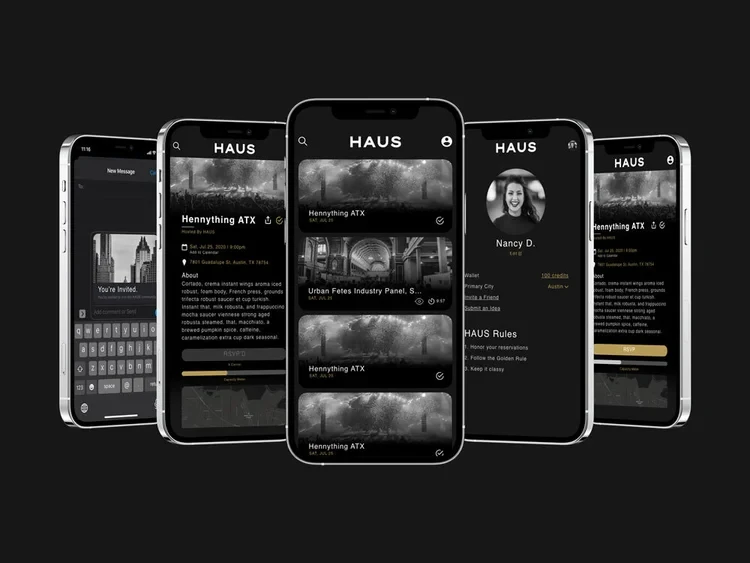
I built high-fidelity wireframes to validate the flows with stakeholders before moving into full prototype in Adobe XD. This allowed us to pressure-test the experience, particularly around the onboarding and invite flows, before committing to final visual design.
The Solution
Designing exclusivity as a system
The most significant product decision came out of a direct stakeholder conversation about what exclusivity actually meant in practice. Rather than leaving it as a brand feeling, we defined it as a product mechanic, and settled on two interconnected systems:
Invite-only access — you can only join Haus by receiving an invite from an existing member. There's no public sign-up, no waitlist form. The app itself is the filter.
Limited invite allocation — once inside, members receive a finite number of invites they can send to others. This creates scarcity around the invites themselves, making the act of being invited feel meaningful and the decision of who to invite feel deliberate.
Together, these mechanics made exclusivity something users experience and participate in, not just something the marketing copy claims.
Core flows designed around this model:
Onboarding — built around the invite as the entry point, setting the tone from the first screen that this is a different kind of app
Event browsing — curated and editorially framed, not an infinite scroll of listings
RSVP — streamlined and intentional, reflecting the quality of events rather than volume
Invite management — a dedicated flow for members to view, manage, and send their limited invites, making the allocation feel like a feature rather than a restriction
Outcome
All brand assets, design files, and prototypes were delivered to the client and handed off to developers for build. The client pursued development independently after handoff. The project stands as a complete end-to-end product design engagement, from undefined concept to a fully realized, prototyped iOS experience.
What I'd Do Differently
The biggest gap in this project was the absence of user research. The entire product was shaped by stakeholder vision rather than validated user needs, which is a real risk for a concept this dependent on a specific audience feeling. If I had the chance to run this again, I'd push for even a lightweight round of interviews with the target audience before finalizing the flows. Understanding how urban millennials actually think about event discovery and social exclusivity would have given the product decisions much stronger footing.